Free, no account
Three reminders, warm to firm.
Fill in the invoice once. Three reminders, warm to firm.
Friendly nudge
3 days after the due dateInvoice [invoice number]: a quick reminder Hello [client name], Invoice [invoice number] for [amount] was due on [due date] and I do not think it has reached me yet. It may well be in hand already, in which case please ignore this. If it is easier, you can pay to [IBAN]. Thanks, [your business]
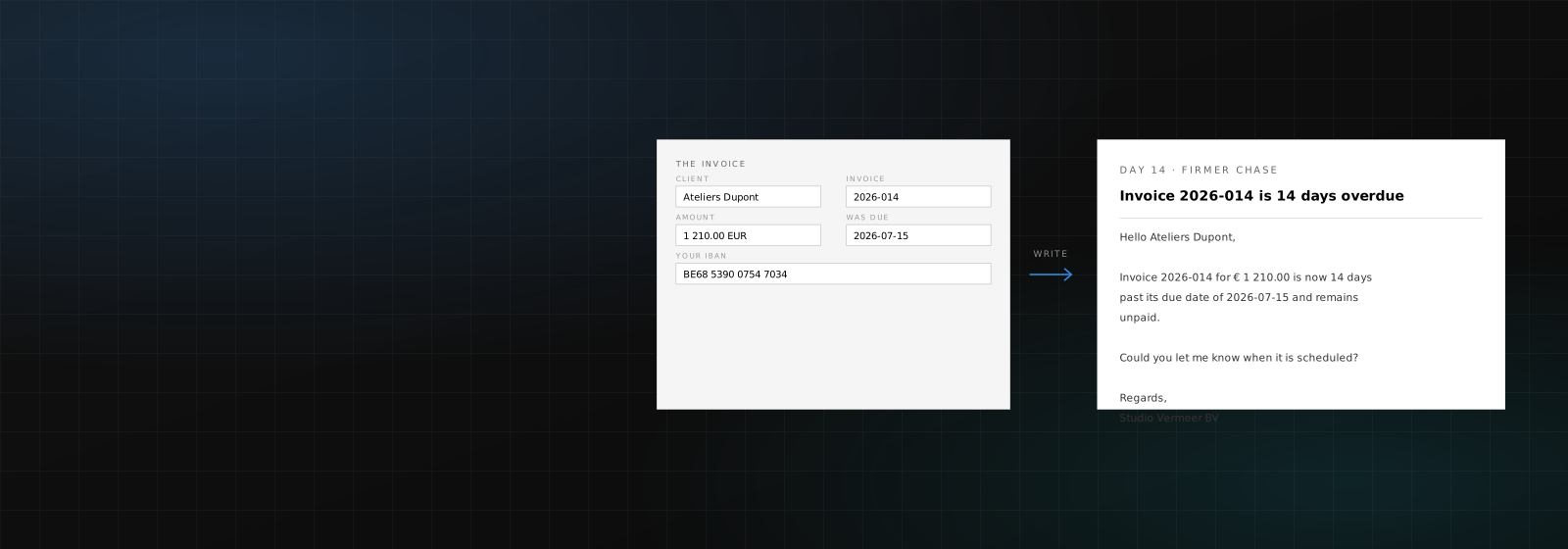
Firmer chase
14 days after the due dateInvoice [invoice number] is 14 days overdue Hello [client name], Invoice [invoice number] for [amount] is now 14 days past its due date of [due date] and remains unpaid. Could you let me know when it is scheduled, or tell me if something is holding it up? If there is a problem with the invoice I would rather hear about it than keep chasing. Payment details: [IBAN] Regards, [your business]
Final notice
30 days after the due dateInvoice [invoice number]: final reminder before further steps Hello [client name], Invoice [invoice number] for [amount], due [due date], is now 30 days overdue despite earlier reminders. Please settle it within the next seven days. If it remains unpaid after that I will send a formal notice and claim the statutory interest and fixed recovery fee I am entitled to under the late payment rules. I would much rather close this amicably. Payment details: [IBAN] Regards, [your business]
This is the same three-step ladder weBiller sends on its own: it watches the due date, sends each stage, and stops the moment the invoice is paid.
Runs in your browser
Nothing you type here is uploaded, logged, or stored. The file is built on your own machine and disappears when you close the tab.
Why a ladder, not one email
Because one email is easy to ignore and a legal threat is too much for an invoice that is three days late. Escalation does the work: a nudge that assumes it is an oversight, a chase that asks for a date, and a final notice that names what happens next. Most invoices settle at stage one, and the ones that do not, you have a paper trail for.
Getting the tone right
The first one should let the client off the hook: it may already be paid, ignore this if so. The second should ask a question rather than repeat the demand, because if something is wrong with the invoice you want to know. The third has to state a consequence and mean it. A final notice you do not follow through on teaches the client to ignore the next one.
When to send them
Three days, fourteen days, thirty. Early enough that it looks like a system rather than a grievance, spaced enough that you are not nagging. These are the offsets weBiller uses when it does this automatically.
Questions, answered
Is it free?
Yes. No account, nothing stored.
What language are they in?
Whichever language you are reading this page in. Switch at the top of the page.
Should I claim interest?
You are usually entitled to. The late payment interest calculator works out the figure and the demand letter claims it formally.
Can this happen automatically?
That is what weBiller does: it watches the due date, sends each stage and stops the moment the invoice is paid.
Wrong answer, or a tool that isn’t here?
Tell us which tool and what you expected. Requests are most of how this list grows, and if the wording here reads wrong, say so.
Your next invoice takes a minute.
Free while in early access. Bring your clients, your currencies, and your logo.