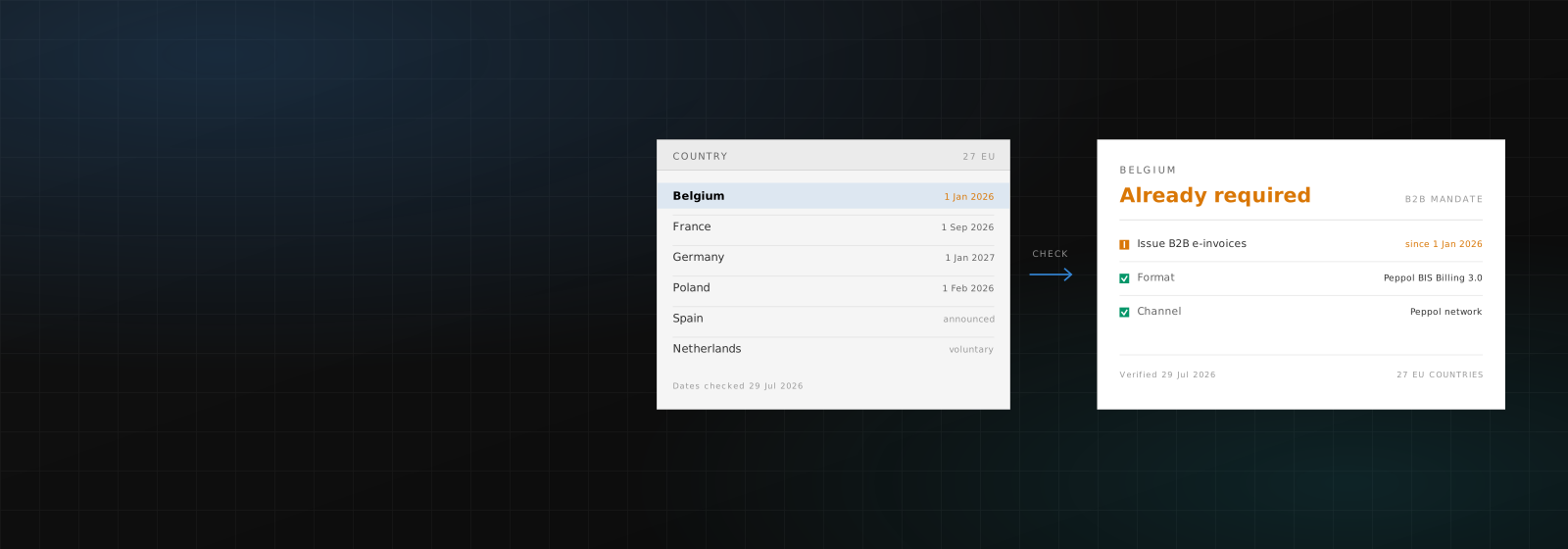
Mandates · reviewed 29 July 2026
Find out what your country already requires of you.
Three questions and you know your format, your channel, and the date it starts.
Worth knowing where you are
- The tolerance period ended on 31 March 2026. Penalties since April run €1,500, then €3,000, then €5,000 for repeat failures.
- The mandate follows VAT registration. Businesses exempt under article 44 and the flat-rate scheme are outside it.
Where you stand
You have time, but there is a date
The date below is set. Use the time. The last month is when every provider is busy.
- Must be able to receive
- 2026-01-01
- Must issue e-invoices
- 2026-01-01
- Format
- Peppol BIS Billing 3.0 (UBL)
- How it travels
- The Peppol network, through an Access Point
What to do, in order
- 1Register a Peppol identifier (usually your enterprise or VAT number) with an Access Point.
- 2Check your invoicing software actually emits the format, not just a PDF.
- 3Tell your customers, and ask for their electronic address.
- 4Keep the structured file, not only the PDF. The XML is the original.
Table reviewed 2026-07-29. Mandate dates move, so confirm with your own tax authority before spending money on it.
Runs in your browser
Nothing you type here is uploaded, logged, or stored. The file is built on your own machine and disappears when you close the tab.
What this answers
Whether you have to receive structured e-invoices, whether you have to issue them, from when, in which format, and through which channel. Those are five different answers and most summaries give you one. The distinction that matters most is the first two: in France everyone must be able to receive from September 2026, but a small business has another year before it must issue.
Receiving and issuing are different dates
Every phased mandate starts with receiving, because a mandate on senders is worthless if the recipients cannot take delivery. So the first date is usually the one nobody plans for: it arrives while you are still thinking about the second. Germany has been in that state since January 2025: no obligation to issue yet, a hard obligation to accept what arrives.
What "ready" means in practice
Three things, in this order. An address on the network, which is an identifier registered through a provider and not an email address. Software that emits the format rather than a PDF of it. And an archive of the structured file, because the XML is the legal original and a printout of it is not. The steps panel lists them for your country.
What this is not
It is a dated table, not advice, and it covers the countries with something to say rather than all twenty-seven. Deadlines in this field move, get postponed and occasionally arrive early: Spain’s dates are announced and still not fixed in law. The review date is on the page for exactly that reason. Confirm with your own tax authority before you spend money on it.
Questions, answered
Is it free?
Yes. No account, and nothing you answer leaves your browser.
How current are these dates?
The table was reviewed on 29 July 2026 and the page says so. Mandates slip. The sensible use of this tool is to find out which rules apply to you at all, then confirm the date with your tax authority.
Am I exempt if I am not VAT-registered?
Usually, yes. Most mandates follow VAT registration, so businesses outside it (the Belgian article 44 exemptions, for instance) are outside the mandate too. You may still be asked to receive one.
Do I have to pay for an Access Point?
For Peppol countries, yes: nothing reaches the network without a registered provider. France requires a certified PDP. Poland and Italy run national platforms you can use directly. weBiller sends over Peppol for you.
Wrong answer, or a tool that isn’t here?
Tell us which tool and what you expected. Requests are most of how this list grows, and if the wording here reads wrong, say so.
Your next invoice takes a minute.
Free while in early access. Bring your clients, your currencies, and your logo.