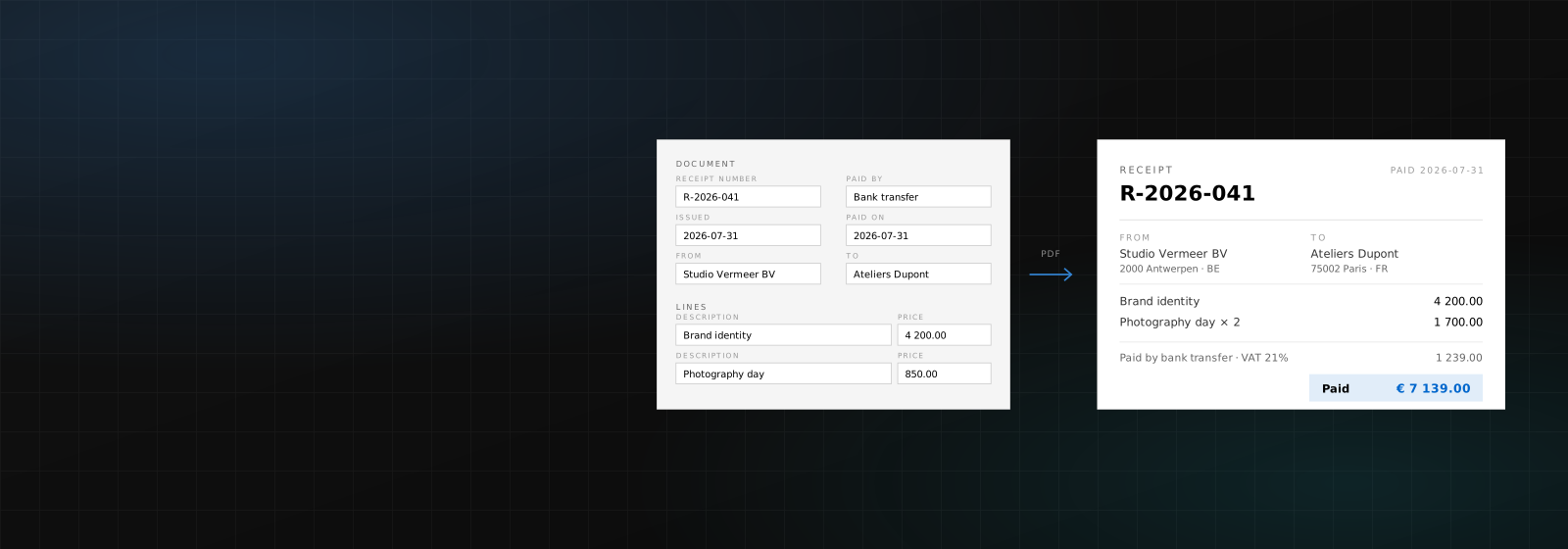
Receipt
—
- Issued
- —
- Paid by
- Bank transfer
From
—
BE
To
—
BE
| Description | Qty | Unit price | VAT | Total |
|---|---|---|---|---|
| — | 1 | €0.00 | 21% | €0.00 |
- Net
- €0.00
- Total
- €0.00
Free, no account
Say what was paid, how, and when. Save the PDF.
Your document
Receipt
—
From
—
BE
To
—
BE
| Description | Qty | Unit price | VAT | Total |
|---|---|---|---|---|
| — | 1 | €0.00 | 21% | €0.00 |
Runs in your browser
Nothing you type here is uploaded, logged, or stored. The file is built on your own machine and disappears when you close the tab.
A receipt proves money changed hands. An invoice asks for it. The two are not interchangeable and your bookkeeping wants both: the invoice for what was owed, the receipt for what was settled. This one prints the amount, how it was paid, the date it arrived, and the invoice it belongs to.
Cash is the obvious case: there is no bank line to point at, so the paper is the only record. Then there is the customer who pays a deposit and wants it acknowledged, the person reclaiming an expense, and anyone paying on someone else’s behalf. A customer who paid by transfer and still asks for a receipt usually wants confirmation that you consider the invoice closed.
A receipt repeats the VAT that was on the invoice; it does not charge it again. Enter the same rate and the same treatment as the original and the two documents will agree, which is the point of the pair. In most of Europe a receipt is not a substitute for a VAT invoice, and a business customer needs the invoice itself to reclaim the VAT.
It does not know your invoices, so it cannot check that the amount matches or that the money really arrived. It keeps nothing either: no numbering that remembers where it got to, no record of who paid what. That part is what an account is for.
Yes. No account, no watermark, no limit on how many you write.
Nowhere. The page has no server behind it: the PDF is built on your own machine and closing the tab deletes everything.
Press "Save as PDF". The file is generated in your browser and contains only the document: not the form, not the rest of the site.
Yes. A receipt that names the invoice it settles can be reconciled by anyone; one that does not is a loose piece of paper. The field is there for exactly that.
It is the kind of record they expect you to keep, but the rules on cash differ by country and some trades have extra ones: registers, sequential numbering, daily takings. If cash is a large part of what you take, ask your accountant rather than a web page.
Wrong answer, or a tool that isn’t here?
Tell us which tool and what you expected. Requests are most of how this list grows, and if the wording here reads wrong, say so.
Free while in early access. Bring your clients, your currencies, and your logo.